Legendary Archery Masters: Fourteen Iconic Figures in Japanese Kyudo History
April 27, 2026
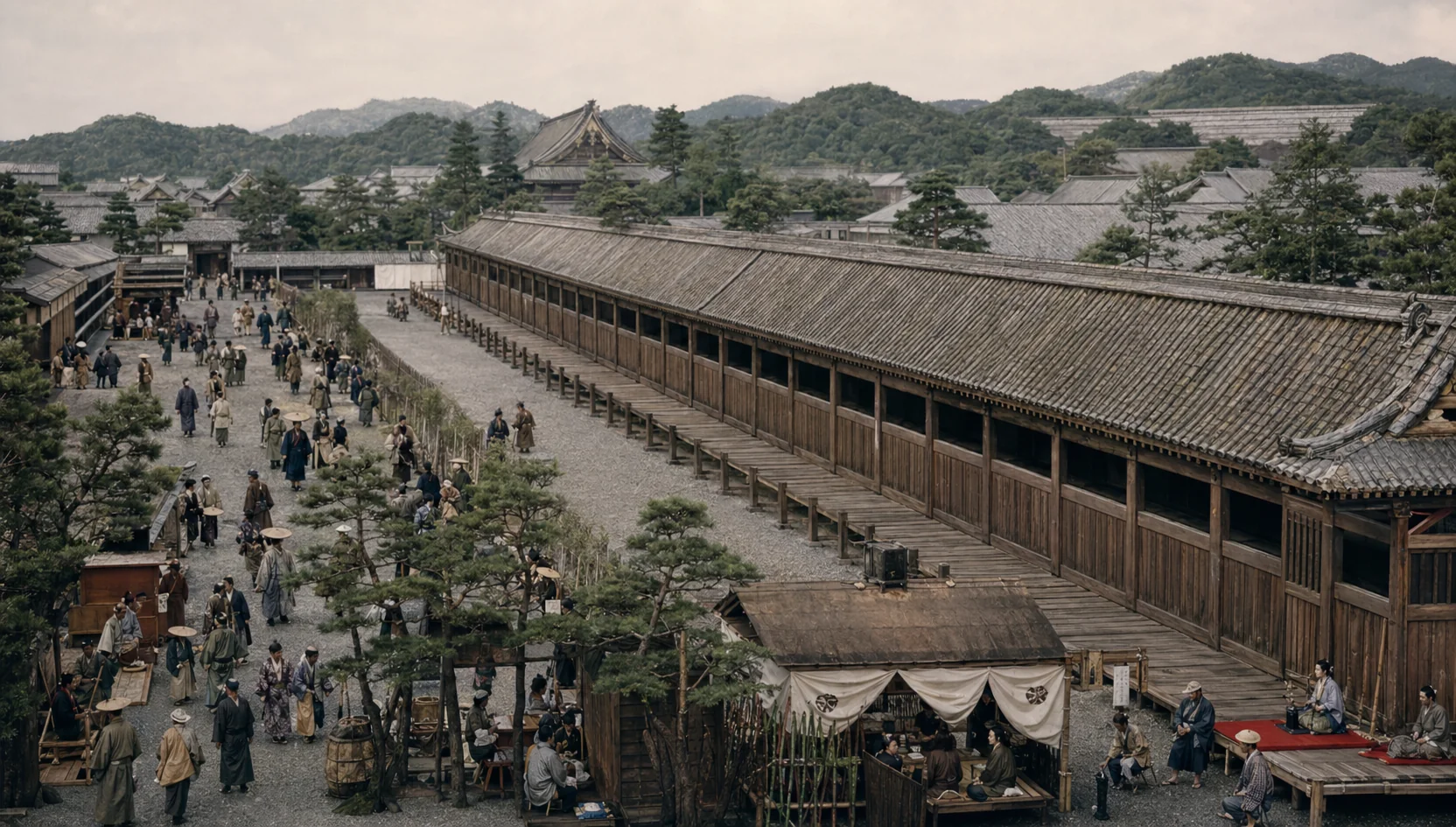
From Minamoto no Yoshiie and Minamoto no Tametomo in the Heian period, to Ogasawara Nagakiyo and Takeda Nobumitsu in Kamakura, Heki Danjo Masatsugu and Yoshida Shigekata in Muromachi, Yoshimi Junsei, Hoshino Kanzaemon, and Wasa Daihachiro in Edo, Ando Hayataro in Bakumatsu, and Honda Toshizane and the archery saint Awa Kenzo in the modern era. Fourteen iconic figures in Japanese archery history.
The history of Japanese archery spans over 800 years, from the Heian period to the Meiji era. This article profiles fourteen iconic figures from the 11th to the late 19th century. Each came from different backgrounds — military commanders, domain retainers, school founders, scholars, and Bakumatsu warriors — yet all are recognized in historical records as representative masters of the bow. This article covers figures up to the Meiji era; modern kyudo practitioners are beyond its scope.
I. Minamoto no Yoshiie (源義家, 1039–1106)
A military commander of the late Heian period and eldest son of Minamoto no Yoriyoshi. He underwent his coming-of-age ceremony at Iwashimizu Hachiman Shrine at age seven, earning the epithet "Hachimantaro." Revered by later warrior houses as a founding figure of the Minamoto clan legend, he lived to age 68.
Yoshiie was famed for his powerful bow. He fought alongside his father Yoriyoshi in the Former Nine Years' War (1051–1062) against the Abe clan, and later intervened in the Kiyowara clan's internal strife during the Latter Three Years' War (1083–1087). Historical records describe him felling enemy commanders with his bow in the chaos of battle. The contemporary song collection Ryojin Hisho describes him: "Even on mountains where eagles dwell, other birds may still nest — yet Hachimantaro alone inspires dread," attesting to his fearsome reputation among the populace.
Yoshiie's historical significance transcends mere martial valor. He is regarded as one of the originators of the warrior house tradition of "kyuba no ie" (houses of bow and horse). Later warrior leaders such as Minamoto no Yoritomo, Minamoto no Yoshitsune, and Ashikaga Takauji all looked to Yoshiie as their spiritual ancestor.
II. Minamoto no Tametomo (源為朝, 1139–1170)
A warrior of the late Heian period, the eighth son of Minamoto no Tameyoshi and great-grandson of Minamoto no Yoshiie. Known as "Chinzei Hachiro" because he was sent to Kyushu at age thirteen and eventually declared himself lord of the region.
Tametomo is celebrated in the Hogen Monogatari for his superhuman strength and mighty bow. Records describe him as roughly seven shaku tall (about 210 cm), with a left arm four sun (about 12 cm) longer than his right, wielding a "five-man bow" that required four people to draw. Defeated in the Hogen Rebellion of 1156, he was exiled to Izu Oshima and took his own life in 1170 when attacked by shogunate forces, at the age of 32.
After his death, folk legends claimed he escaped to Hachijojima or even the Ryukyu Kingdom — Shunten, founder of the Shunten Dynasty of Ryukyu, is said to have been Tametomo's son. Among ukiyo-e, Tsukioka Yoshitoshi's Yoshitoshi Musha Burui: Chinzei Hachiro Tametomo remains one of the most widely known depictions.
III. Ogasawara Nagakiyo (小笠原長清, 1162–1242)
An early Kamakura-period warrior and founder of the Ogasawara-ryu school of mounted archery and court etiquette. Born into the Kai-Genji clan as the second son of Kagami Tomitsu, his paternal line shared the same Kawachi-Genji ancestry as Minamoto no Yoritomo. In 1187 (Bunji 3), at age 26, Yoritomo appointed him "Kyuho Shihan" — master of archery, horsemanship, and protocol for the warrior class.
At the 1193 (Kenkyu 4) yabusame ceremony held at Tsurugaoka Hachimangu, Nagakiyo was selected as a mounted archer alongside Takeda Nobumitsu (also Kai-Genji), Unno Yukiuji, and Mochizuki Shigetaka — the four collectively known as the "Four Heavenly Kings of Bow and Horse." This ceremony became one of the prototypes for the warrior-class yabusame tradition.
Nagakiyo retired to Shinano Province in his later years and passed away in 1242 (Ninji 3) at the age of 81. His descendants carried on the "Kyuho" tradition for generations. The Ogasawara-ryu has been transmitted continuously for over 850 years — from Kamakura through Muromachi and Edo to the present day — and is recognized by the Nihon Kobudo Kyokai as a traditional school of mounted archery. While Nagakiyo is honored as the school's founder, some scholars attribute the actual systematization to his seventh-generation descendant Ogasawara Sadamune during the Nanbokucho period.
IV. Takeda Nobumitsu (武田信光, 1162–1248)
An early Kamakura-period warrior and founder of the Takeda-ryu school of mounted archery. Born into the Kai-Genji clan as the son of Takeda Nobuyoshi. Born in the same year as Ogasawara Nagakiyo (1162), he was also a member of the Kai-Genji and one of the "Four Heavenly Kings of Bow and Horse."
Nobumitsu served under three successive shoguns — Minamoto no Yoritomo, Yoriie, and Sanetomo — and distinguished himself on the shogunate's side during the Jokyu War (1221), receiving the governorship of Aki Province (modern-day Hiroshima Prefecture) and founding the Aki-Takeda clan. The Takeda-ryu tradition of mounted archery was passed down through his descendants to Aki and Wakasa provinces, later preserved by the Hosokawa domain during the Edo period, and continues today through the Takeda-ryu Yabusame Preservation Society.
The Takeda-ryu and Ogasawara-ryu stand as the two great mainstreams of warrior mounted archery. Each spring during cherry blossom season, the yabusame ceremonies held at Tokyo's Meiji Shrine, Nara's Kasuga Taisha, and Kamakura's Tsurugaoka Hachimangu are still performed by successors of these two schools. Nobumitsu passed away in 1248 (Hoji 2) at the age of 87 and was buried in Aki Province.
V. Nasu no Yoichi (那須與一, 1169?–1189?)
A late Heian-period warrior who fought for the Minamoto clan during the Genpei War; son of Nasu Suketaka. His birth and death years are disputed, and since his exploits appear primarily in the Heike Monogatari and Genpei Seisui-ki, scholars remain uncertain whether he was a historical figure.
Yoichi is best known for the "Fan Target" episode at the Battle of Yashima in 1185 (Genreki 2). The Taira forces displayed a fan-shaped target on a small boat at sea, and the young Yoichi was ordered by Minamoto no Yoshitsune to shoot it down. The Heike Monogatari describes how he nocked a whistling arrow, drew his bow to its fullest, and released — the arrow grazed the rivet of the fan, sending it spiraling into the air, its red face drifting on the spring breeze before settling on the waves in a swirl of crimson and white.
For this feat, Yoichi was granted estates in five provinces by Minamoto no Yoritomo. His grave is said to be at Sokujoin Temple in Kyoto. The Yashima "Fan Target" scene remains a staple of Japanese middle school literature textbooks to this day.
VI. Asahina Yoshihide (朝比奈義秀, 1176–?)
An early Kamakura-period warrior, the third son of Wada Yoshimori, a retainer of the Kamakura shogunate. His mother is said to have been the legendary female warrior "Tomoe Gozen." He received the surname "Asahina" from his domain in Asai District, Awa Province (modern-day southern Chiba Prefecture). His extraordinary strength and skill with bow and horse are documented in multiple contemporary sources.
Yoshihide's exploits center on the Wada Rebellion of 1213 (Kenpo 1). When Hojo Yoshitoki clashed with Wada Yoshimori, Yoshihide led 150 Wada horsemen in a surprise assault on the Shogun's residence, charging in from the south courtyard and cutting down several guards. The Azuma Kagami describes his prowess as "divine strength" (kami no gotoki soriki). After the Wada clan's defeat, Yoshihide's fate is unknown; folk legends claim he fled to Awa or Goryeo, but no reliable sources confirm this.
The Azuma Kagami and Soga Monogatari also record Yoshihide's archery skill and brute strength, including legends of him catching three sharks bare-handed in the sea as an offering to Minamoto no Yoritomo, and carving the Asahina Kiridoshi pass (one of Kamakura's Seven Entrances, still extant) in a single night. Tsukioka Yoshitoshi's ukiyo-e Ikkai Zuihitsu: Asahina Saburo Yoshihide is a widely known depiction.
VII. Heki Danjo Masatsugu (日置彈正政次, 1443–1502)
A late Muromachi-period archery master and founder of the Heki-ryu, revered as the "restorer of Japanese archery." Traditional records place his origin in Heki, Omi Province (modern-day Ryuo-cho, Shiga Prefecture), though scholars debate whether he actually existed — some research suggests Heki Masatsugu and Yoshida Shigekata (founder of the Yoshida-ryu) may have been the same person, or that Heki Masatsugu is a legendary figure.
Masatsugu's era coincided with the early Sengoku period, when archery was still dominated by the ceremonial style inherited from the Kamakura period, serving primarily as ritual and status symbol for the warrior class. The Heki-ryu was combat-oriented, emphasizing infantry shooting (ground-based archery) and simplified form to achieve fast, accurate hits on the battlefield. This marked the critical juncture in Japanese archery history when "ceremonial archery" (reisha) and "martial archery" (busha) diverged.
Masatsugu's disciple Yoshida Shigekata inherited his methods and later branched into numerous sub-schools: Owari Chikurin-ha, Kishu Chikurin-ha, Sekka-ha, Insai-ha, and others. Edo-period masters such as Hoshino Kanzaemon (Sekka-ha), Wasa Daihachiro (Kishu Chikurin-ha), and Ando Hayataro (Sekka-ha and Chikurin-ha) all descended from the Heki-ryu system. Honda Toshizane, who adapted the Heki-ryu into the modern shomen uchiokoshi method during the Meiji era, also trained in the Owari Chikurin-ha lineage.
VIII. Yoshida Shigekata (吉田重賢, 1463–1543)
An early Sengoku-period archery master and founder of the Yoshida-ryu (the major early-modern branch of Heki-ryu). Born in Kawamori, Gamo District, Omi Province (modern-day Ryuo-cho, Shiga Prefecture), a descendant of the Yoshida family of the Omi-Genji Sasaki clan. During the Sengoku period he served as a senior retainer of the Rokkaku clan, the shugo of Omi.
In his youth, Shigekata studied the old schools descended from the Genpei era (Henmi-ryu, Takeda-ryu, Ogasawara-ryu), then trained under Heki Danjo Masatsugu in his innovative shooting methods. Shigekata organized and systematized Heki-ryu techniques for transmission to his descendants, and this lineage became known as "Yoshida-ryu" or "Heki-Yoshida-ryu." Through Shigekata's efforts, the Heki-ryu evolved from an individual innovation into a hereditary system of martial knowledge, becoming the dominant school of early-modern archery.
Shigekata earned such accolades as "the finest in Japan" and "a peerless master." His deeds are recorded in multiple historical works including Honcho Koso-den and Buke Jiki. He passed away on April 13, 1543 (Tenbun 12), at the age of 81. His son Yoshida Shigemasa (Izumo no Kami) carried on the family tradition and spawned numerous branches — Owari Chikurin-ha, Kishu Chikurin-ha, Sekka-ha, Insai-ha, Okura-ha, and more. The Edo-period archery masters Hoshino Kanzaemon, Wasa Daihachiro, and Ando Hayataro all belonged to this lineage.
IX. Yoshimi Junsei (吉見順正, 1602?–1686)
An early Edo-period retainer of the Kishu domain, birth name Yoshimi Daiuemon Tsunetake. A man of both literary and martial accomplishment with profound archery skill. In 1656 (Meireki 2), under the name "Yoshimi Daiuemon," he set the toshiya record of 6,343 arrows at Sanjusangendo, earning the title "Tenka-ichi" (best under heaven) as the highest record holder of the time. He later became a senior mentor to the next generation of toshiya masters, including Hoshino Kanzaemon of the Owari domain and Wasa Daihachiro of the Kishu domain. In his later years he took Buddhist vows, moved to the grounds of Daitokuji Temple in Kyoto, and adopted the dharma name "Junsei."
Junsei's most important surviving work is the Shahokun (Precepts on Shooting). This short text on the essentials of shooting is known for phrases such as "yumi wo izushite hone wo iru" (shoot not the bow but the bone). The Shahokun, paired with the "Shayi" chapter of the Book of Rites, is still included at the front of the Kyudo Kyohon (Kyudo Manual) published by the All Nippon Kyudo Federation, making it one of the foundational texts recited by modern kyudo practitioners.
Many kyudo dojos across Japan display calligraphy scrolls of the Shahokun on their walls as a spiritual guide for daily practice. This short text also appears regularly in the written examination questions for modern kyudo rank testing — one of the rare kyudo documents that has endured continuously from the Edo period to the present day.
Supplement: Historical "Tenka-ichi" Records of the Toshiya
The toshiya "Oyakazu" records at Sanjusangendo are preserved in the Yakazu-cho (Arrow Tally Register, compiled by Fukui Kawachi no Jo / Katsumura Jiuemon, published during the Keio era), which meticulously records every competition and record-holder's name from 1606 (Keicho 11) through 1866 (Keio 2). In addition to the previously discussed Yoshimi Junsei (6,343 arrows in 1656), Hoshino Kanzaemon (8,000 arrows in 1669), and Wasa Daihachiro (8,133 arrows in 1686), other named "Tenka-ichi" record-holders in the Yakazu-cho include:
- Asaoka Heibei (1606): The earliest confirmed Tenka-ichi (the exact tally varies by source — 51 arrows per the Yakazu-cho, 55 per Irie Kohei's 2008 paper)
- Yoshida Okura (Genna era, 1615–1624): Successive record-breaking
- Kasuya Sakon (Genna era): Records reaching 534 to 1,583 arrows
- Yajima Heizaemon (Genna 7, 1621): 900 toshiya arrows
- Saito Kanbei (Kanei 5, 1628): 1,444 toshiya arrows
- Ochiai Magokuro (Kanei era): Successive tallies of 1,730 and 1,852 arrows
From the mid-17th century onward, toshiya's popularity spread nationwide. Domains such as Kishu, Owari, and Sendai established their own "do-gata" (hall-style practice ranges), sending their best retainers to compete at Kyoto's Sanjusangendo. The Kishu domain was especially generous with successful archers — according to the Nanki Tokugawa-shi, Volume 164: "Should one achieve the Hon-do Oyakazu Soichi, even if a mere younger son, he shall immediately receive a new fief of 500 or 300 koku; should one achieve the Han-do Soichi, he shall receive 80 or 60 koku in rice. There is nothing comparable among all martial arts."
Wasa Daihachiro's 1686 record marked the pinnacle; challengers declined sharply afterward and virtually ceased by the mid-18th century. The last Meiji-era "Oyakazu" record was set by Wakabayashi Masayuki in 1899 (Meiji 32) with 4,457 arrows (recorded in Nihon Kyudo Shiryo, Volume 6).
X. Hoshino Kanzaemon (星野勘左衛門, 1641–1696)
An early Edo-period archer and retainer of the Owari domain, birth name Hoshino Shigenori. One of the celebrated record-holders in the toshiya competition held at Sanjusangendo in Kyoto.
Toshiya was a contest in which archers shot through the full length of Sanjusangendo's western veranda — approximately 121 meters — to reach the far end. In 1669 (Kanbun 9), Hoshino achieved the "Oyakazu" record at Sanjusangendo, landing 8,000 arrows out of 10,542 total shots, earning the title "Tenka-ichi" (best under heaven). This record stood until 1686, when it was broken by Wasa Daihachiro of the Kishu domain.
Hoshino remained active in the archery world in his later years. According to historical records, when Wasa Daihachiro's left hand became congested with blood during his attempt to break the toshiya record, the former "Tenka-ichi" Hoshino personally appeared and used a small knife to let blood from his hand — an anecdote often cited as an example of mutual respect among archers.
XII. Ando Hayataro (安藤早太郎, 1816?–1864)
A Bakumatsu-era archery master from Koromo Domain, Mikawa Province (modern-day Toyota City, Aichi Prefecture), and a Fukucho-Jokin (assistant vice-commander) of the Shinsengumi. Born around 1816 (Bunka 13), he died of battle wounds on July 22, 1864 (Genji 1), following the Ikedaya Incident, at approximately age 48.
Ando studied Heki-ryu archery in Edo under Takagi Oshinsai (also known as Takagi Shinryusai, who later founded the Oshin-ryu), mastering both the Chikurin-ha and Sekka-ha branches. His most notable achievement was a toshiya at the Great Buddha Hall of Todaiji Temple in Nara in 1842 (Tempo 13), landing 8,685 arrows out of 11,500 — setting the Todaiji toshiya record. While the numbers are lower than Wasa Daihachiro's Sanjusangendo record, the conditions at Todaiji differed (range of about 76 meters vs. Sanjusangendo's 121 meters), making this an equally significant record in Edo-period kyudo history.
In May 1863 (Bunkyu 3), Ando joined the Shinsengumi as Fukucho-Jokin. While the Shinsengumi was famous for swordsmanship, the unit also maintained archery training under Ando's instruction. During the Ikedaya Incident on June 5, 1864, Ando was assigned to Kondo Isami's squad alongside Okuzawa Eisuke and Nitta Kakuzaemon, tasked with guarding the rear courtyard. He was severely wounded in the fierce fighting and died approximately six weeks later.
Ando is one of extremely few individuals in history who held the dual distinction of "Todaiji toshiya record holder" and "Shinsengumi member." His grave is located within Kyoto. This site has a dedicated article on his connection to the Shinsengumi: Ando Hayataro: El maestro arquero del Shinsengumi.
XIII. Honda Toshizane (本多利實, 1836–1917)
An archery master spanning the Bakumatsu and Meiji eras, born into a hatamoto family in late Edo, son of Honda Toshishige. His art name was "Seikyusai." He is revered as one of the "Archery Saints" (Kyusei).
Honda began studying archery under his father at age six. By twenty-five he had received full transmission (kaiden inka) of the Heki-ryu Owari Chikurin-ha, becoming the eighth-generation headmaster of the Edo Chikurin-ha. After the Meiji Restoration abolished the samurai class and traditional archery faced an existential crisis, Honda dedicated himself to adapting warrior archery into a method accessible to ordinary citizens, converting the Heki-ryu's "shamen uchiokoshi" (diagonal raising) into "shomen uchiokoshi" (frontal raising) and fusing ceremonial and martial archery.
In 1892 (Meiji 25) he became archery instructor at the First Higher School, and in 1902 (Meiji 35) at Tokyo Imperial University. Through university education, Honda disseminated his reformed shooting method nationwide. This method became a major source of modern kyudo — particularly the "shomen uchiokoshi" basic form adopted by the All Nippon Kyudo Federation. Honda also established the Honda-ryu.
Scholars regard Honda as the pivotal figure in the transition "from kyujutsu to kyudo" — a modernization parallel to the evolution from jujutsu to judo, or from kenjutsu to kendo. He passed away in 1917 (Taisho 6) at the age of 81.
XIV. Awa Kenzo (阿波研造, 1880–1939)
A kyudo master active from the Meiji through early Showa eras, born in Yokokawa, Ishinomaki City, Miyagi Prefecture. Revered as a "Kyusei" (Archery Saint). He held an exceptionally high status within Japan, and became internationally famous through the writings of his disciple.
Awa moved to Sendai at age 30 and opened a dojo. From 1910 he served as kyudo instructor at the Second Higher School, and in 1927 (Showa 2) founded the "Daishadokyo" (Great Way of Shooting). At the height of his activity, his followers nationwide reportedly numbered fourteen thousand.
Between 1920 and 1926, German philosopher Eugen Herrigel studied archery under Awa for six years while teaching at Tohoku Imperial University. Upon returning to Germany, Herrigel published Zen in der Kunst des Bogenschiessens (Zen in the Art of Archery, 1948). This book became the seminal Western work on Japanese kyudo and Zen Buddhism, has been translated into numerous languages, and remains the single greatest source of international awareness of Japanese kyudo.
Awa himself passed away in Sendai in 1939 (Showa 14) at the age of 59. His grave is at Unsho-ji Temple in Ishinomaki.
Sources
This article is compiled from the following publicly accessible sources. Birth/death years and specific details of historical figures may vary between sources; the following are the primary references used:
- 🔗 Wikipedia (ja): Minamoto no Yoshiie
- 🔗 Wikipedia (ja): Minamoto no Tametomo
- 🔗 Wikipedia (ja): Ogasawara Nagakiyo
- 🔗 Wikipedia (ja): Takeda-ryu (incl. Takeda Nobumitsu)
- 🔗 Wikipedia (ja): Nasu no Yoichi
- 🔗 Wikipedia (ja): Asahina Yoshihide
- 🔗 Wikipedia (ja): Heki-ryu (incl. Heki Danjo Masatsugu)
- 🔗 Wikipedia (ja): Yoshida Shigekata
- 🔗 Wikipedia (ja): Toshiya (incl. Yoshimi Junsei, Hoshino Kanzaemon, Wasa Daihachiro)
- 🔗 Wikipedia (ja): Wasa Norito (Daihachiro)
- 🔗 Wikipedia (ja): Ando Hayataro
- 🔗 Wikipedia (ja): Honda-ryu Seikyukai (incl. Honda Toshizane biography)
- 🔗 Wikipedia (ja): Awa Kenzo
- 📄 Irie Kohei, "A Study on the Sportification of Martial Arts as Seen in Dosha," Journal of Physical Arts 13(1), 31-47, 2008 (J-STAGE full-text PDF) — The toshiya facts in this article's Supplement section are based on this paper, including the 1606 Asaoka Heibei record of 55 arrows (vs. 51 in the Yakazu-cho), and the quote from Nanki Tokugawa-shi Vol. 164 regarding the Kishu domain's 500/300 koku fief reward system.
- 🔗 National Archives of Japan: Heike Monogatari "Nasu no Yoichi" Exhibition Page
The primary sources directly consulted during the editing of this article are limited to the Irie Kohei 2008 paper listed above and the relevant Wikipedia entries. Other classical sources (Honcho Bugei Shoden, Yakazu-cho, Hogen Monogatari, Heike Monogatari, Azuma Kagami, Nanki Tokugawa-shi originals, etc.) are restricted to cursive-script and image-based archives; the editor did not directly read the original texts, and citations are drawn indirectly through Wikipedia summaries or the Irie 2008 paper. For academic citation, please consult the original texts via print or specialized archival services.
Comienza tu viaje en el Kyudo
