Kyudo Sharei Explained: Etiquette from Entering to Exiting the Shooting Hall
August 16, 2026
Kyudo Sharei Explained: Etiquette from Entering to Exiting the Shooting Hall — When you first enter a Kyudojo, the bow, arrows, and target are usually the first things you notice. What makes Kyudo look different from ordinary archery, however, is often the way archers enter the shooting area, wait, coordinate with one another, and leave after shooting.
When you first enter a Kyudojo, the bow, arrows, and target are usually the first things you notice. What makes Kyudo look different from ordinary archery, however, is often the way archers enter the shooting area, wait, coordinate with one another, and leave after shooting. These movements are not last-minute rules added for a competition. They are part of Kyudo practice itself.
First, separate Rei, Sharei, and Taihai
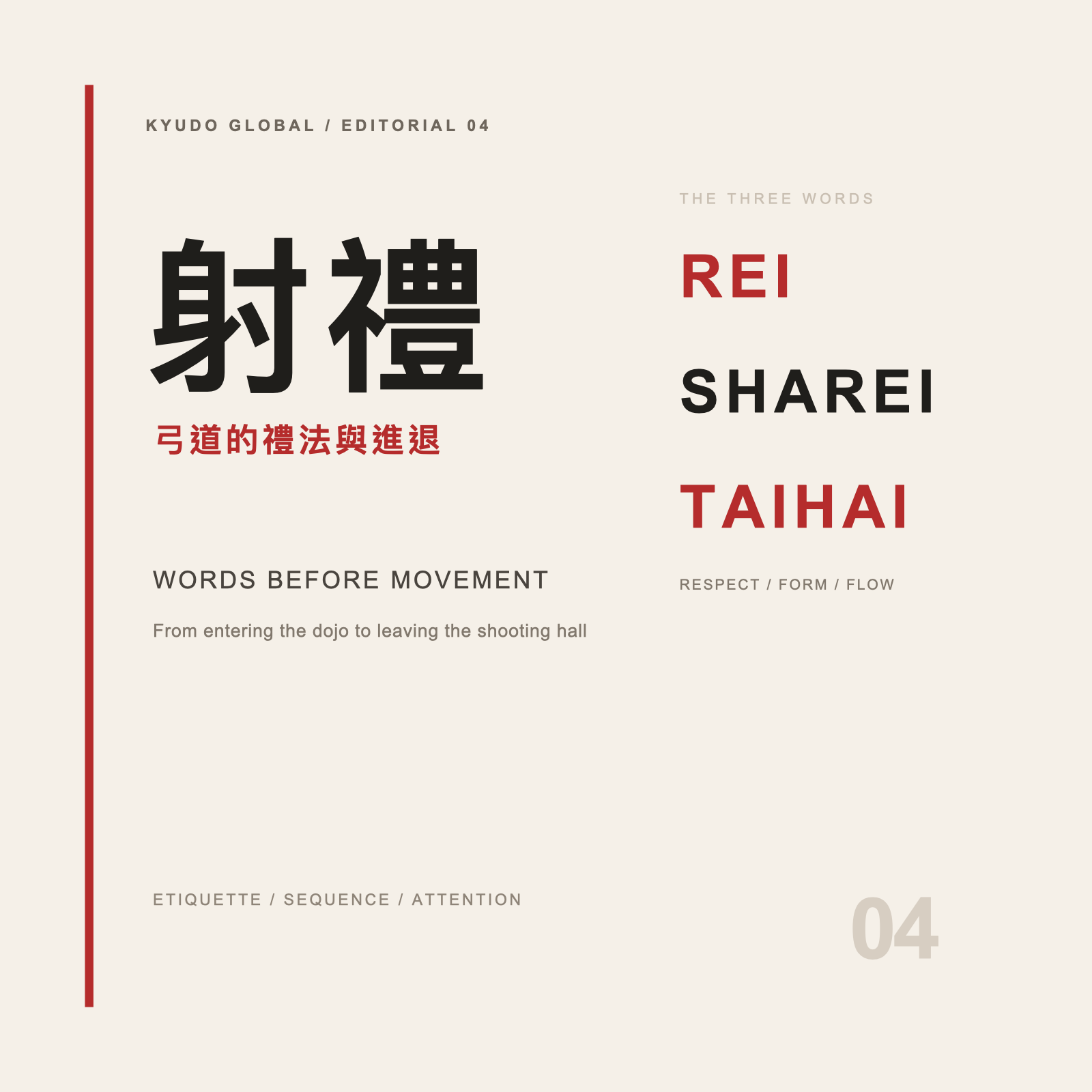
Rei can be understood as conduct that expresses respect and maintains order in human relationships. Sharei is ceremonial shooting performed through a formal structure based on Rei. Taihai refers to the fundamental postures and movements used in the shooting process.
These ideas are not simply “bow first, then shoot.” The International Kyudo Federation presents etiquette and shooting technique as inseparable. The value of sharei is that it places movement, sequence, and mental attitude inside one coherent process. Beautiful etiquette without substance in the shooting is incomplete, just as chasing hits while ignoring etiquette is not the whole of Kyudo.
How is Sharei different from Hassetsu?
Shaho-Hassetsu runs from Ashibumi and Dozukuri through Yugamae, Kai, Hanare, and Zanshin. It focuses on how one arrow is made. Sharei expands the frame: when the archer enters, where they walk, when they sit, how they acknowledge the Kamiza, how they wait for the other archers, and how they exit after the shooting.
Hassetsu is therefore the technical skeleton of a shot, while sharei and taihai provide the order of the whole shooting area. They influence one another, but the eight stage names should not be used as a substitute for every part of shooting etiquette.
From entering to exiting: the basic flow
1. Entering and acknowledging the Kamiza
In the official five-archer examination procedure, archers pay attention to the Kamiza when entering and exiting, then perform Rei or Yū according to the procedure. The point is not to make the movement theatrical. It is to keep a clear sense of direction and order while moving and turning in the shooting area.
2. Honza, Kiza, and Yū
After entering, archers proceed to Honza, sit in Kiza as required, and perform Yū together before moving toward Shai. Beginners do not need to memorize the terms as a chant. It is enough to understand that Honza is a position for waiting and moving as a group, while Shai is the position from which the shooting is performed.
3. Waiting at Shai before shooting
Reaching Shai does not mean immediately drawing the bow. The formal procedure includes turning toward Waki-Shomen, standing the bow, preparing the arrow, and waiting. Waiting is not empty time: it lets the archers in the same line coordinate through the sound of the string and the established order, instead of rushing ahead or falling behind.
4. Keeping order after the shot
After shooting, an archer should not focus only on whether the arrow hit. The formal procedure has archers exit in order, and the movements before and after shooting should not become unnecessarily slow. When Rissha and Zasha use different movements, the official examination guidance says that the standing archer adapts to the seated archers. This is taihai as a shared process, not a solo performance.
Five things beginners should remember
- Do not decide the etiquette only from online videos; details can vary by dojo, school, and formal setting.
- Watch the archer before you, then follow the instructor’s or senior archer’s timing and cues.
- Understand Kamiza, Honza, Shai, and Waki-Shomen as positions and directions, not just Japanese vocabulary.
- Rei is not a performance. It helps the archer keep order while moving, waiting, and shooting.
- Hitting the target is not the only measure of sharei; continuity, stability, and appropriateness to the situation matter too.
Sharei is Kyudo’s beginning and ending
The International Kyudo Federation summarizes the spirit of Kyudo with the idea that shooting begins with Rei and ends with Rei. Shooting does not begin only when the bow is drawn, and it does not finish the instant the arrow leaves. Entering, moving with the other archers, maintaining order after the shot, and leaving are all part of the same arrow’s context.
Beginners therefore do not need to memorize every term and movement at once. First understand where you are, who you are coordinating with, and why the group slows down or waits. Let your instructor correct the details step by step. That is more useful than trying to look correct before you understand the flow.